Calibration: managers align performance scores before they turn into pay rises
Role
UX Designer
also covering product owner tasks
Duration
June – July 2026
2 months
Tools
Claude · Claude Design
FigJam
Outcome
MVP concept
now in development
Intro
Learned is a performance management platform. Companies use it to run review cycles, in which managers evaluate their employees. Soon Learned will handle compensation too, so those evaluations will decide pay rises.
That makes fair scores essential. And managers don't grade alike: one is strict, another generous, a third never gives a top score. Calibration fixes that: managers and HR compare scores across teams, discuss the outliers and agree on one standard. With the EU Pay Transparency Directive asking for objective, gender-neutral pay criteria, that standard is becoming a must-have.
The problem
Learned already had a “Calibrate this review cycle” toggle. It added a calibration status before scores were shared, but no way to actually calibrate.
In user interviews I heard what customers did instead. Some exported the review data to Excel and ran their own sessions. Others left it all to the managers. Some managers checked with each other first, but only on their own initiative, and often skipped it to save time.
For users, the feature had to bring that meeting into Learned: find the scores worth discussing, adjust them fairly, record why.
For the business, the timing mattered. At some customers, a manager still decided alone how big a pay rise would be. Calibration makes scores fair before money depends on them, and helps Learned grow towards larger companies, where it's standard practice.
My approach
1. A flow chart, a lot of questions and prototype v1
The Head of Product briefed me with a first flow chart. Calibration was new to me, so I used Claude as a sparring partner. What does it mean for a company, a manager and an employee? How do Lattice, Culture Amp and Betterworks handle it? I loved learning a new domain, and it paid off: I could ask the questions that mattered early, and talk and design with a much clearer goal.
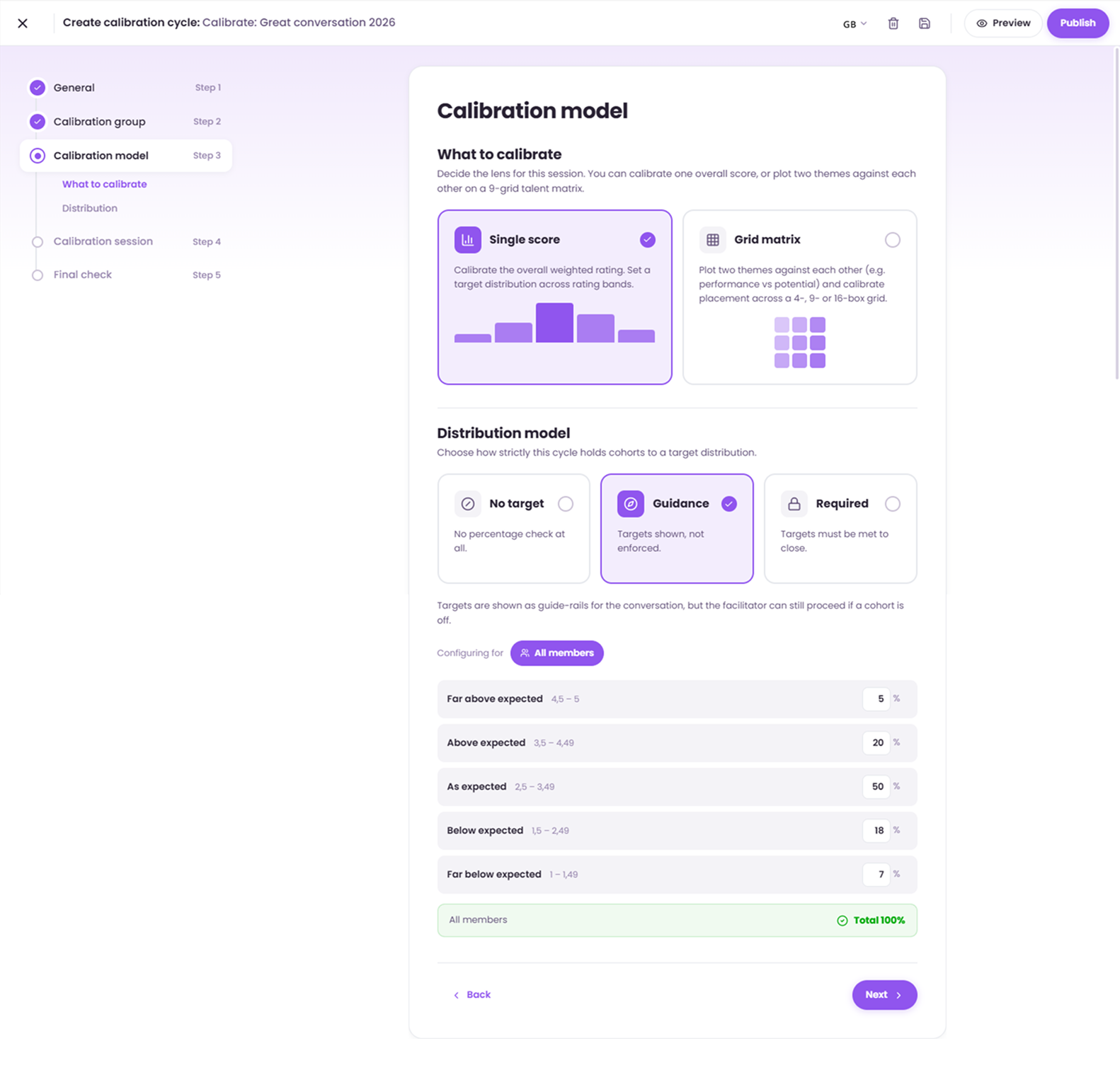
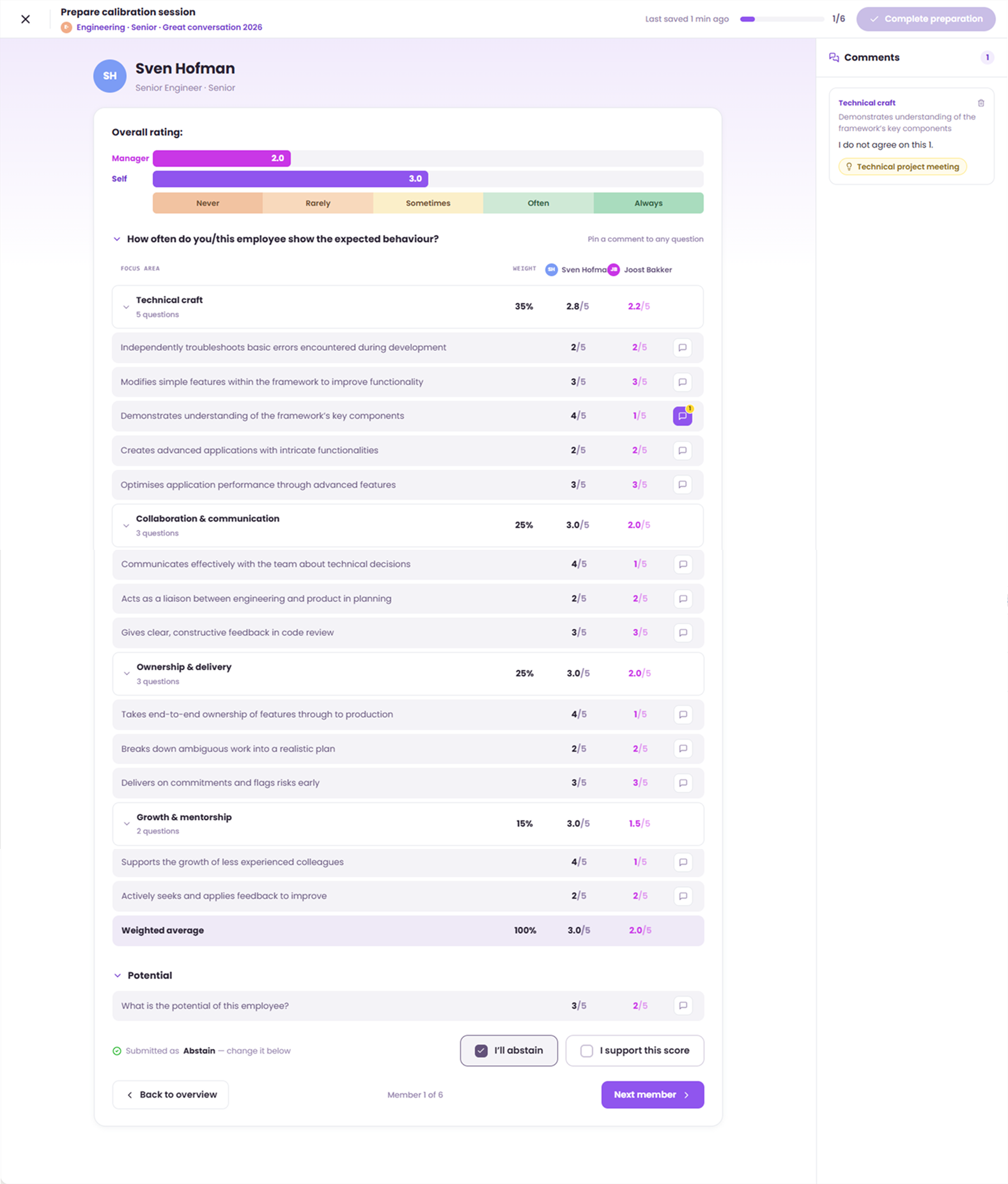
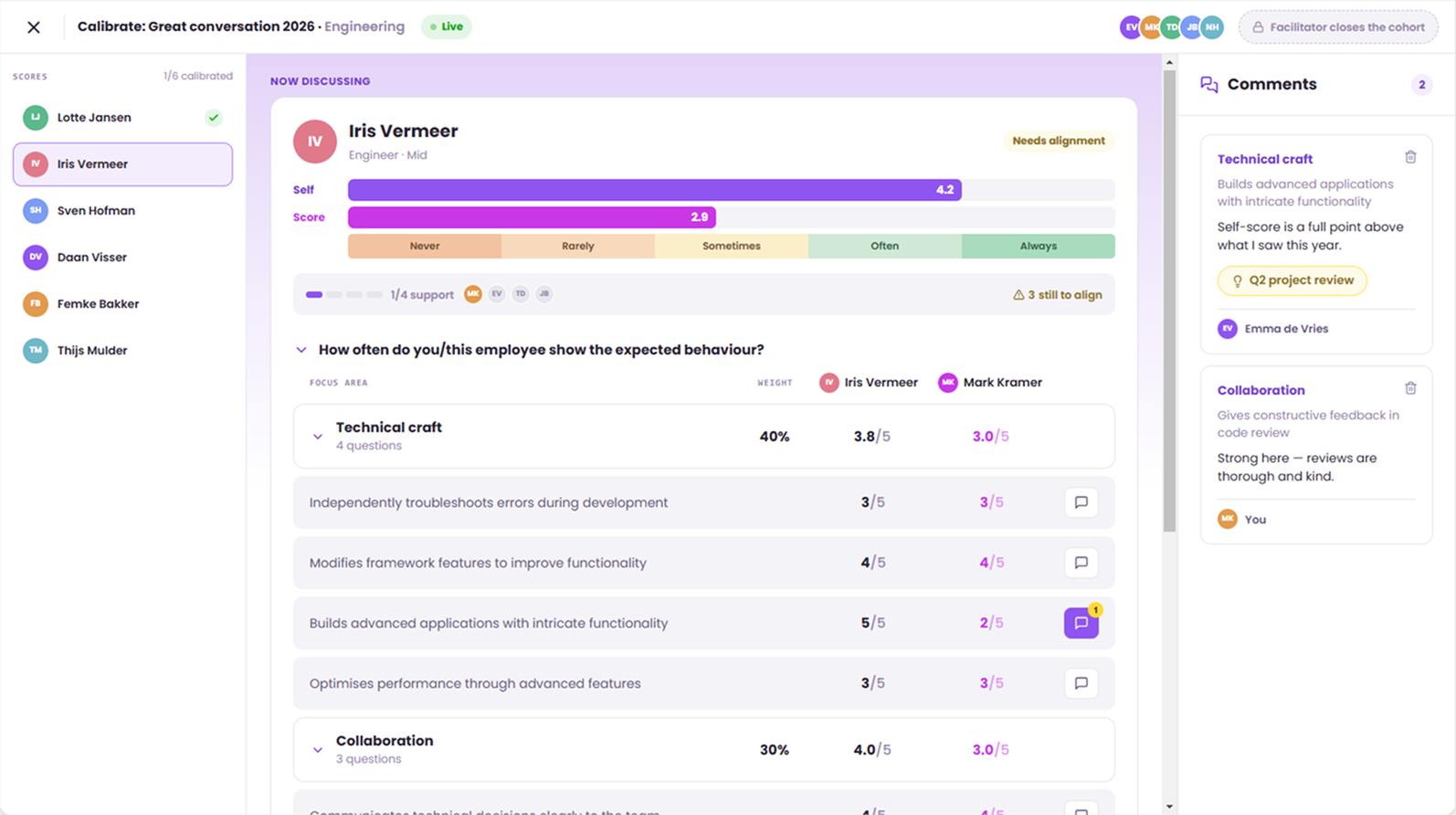
With that, I built prototype v1 in Claude Design. On purpose, it covered the biggest version I could think of: create → prepare → session. Starting big made it easier to cut back to a sensible MVP later.
v1 · Createv1 · Preparev1 · Session
2. Answers, and a first turn
I took the questions that would steer the concept to the Head of Customer Success:
Is every cohort (a group calibrated together) its own cycle, or part of one bigger cycle? → One cycle, so HR sees all cohorts in one dashboard.
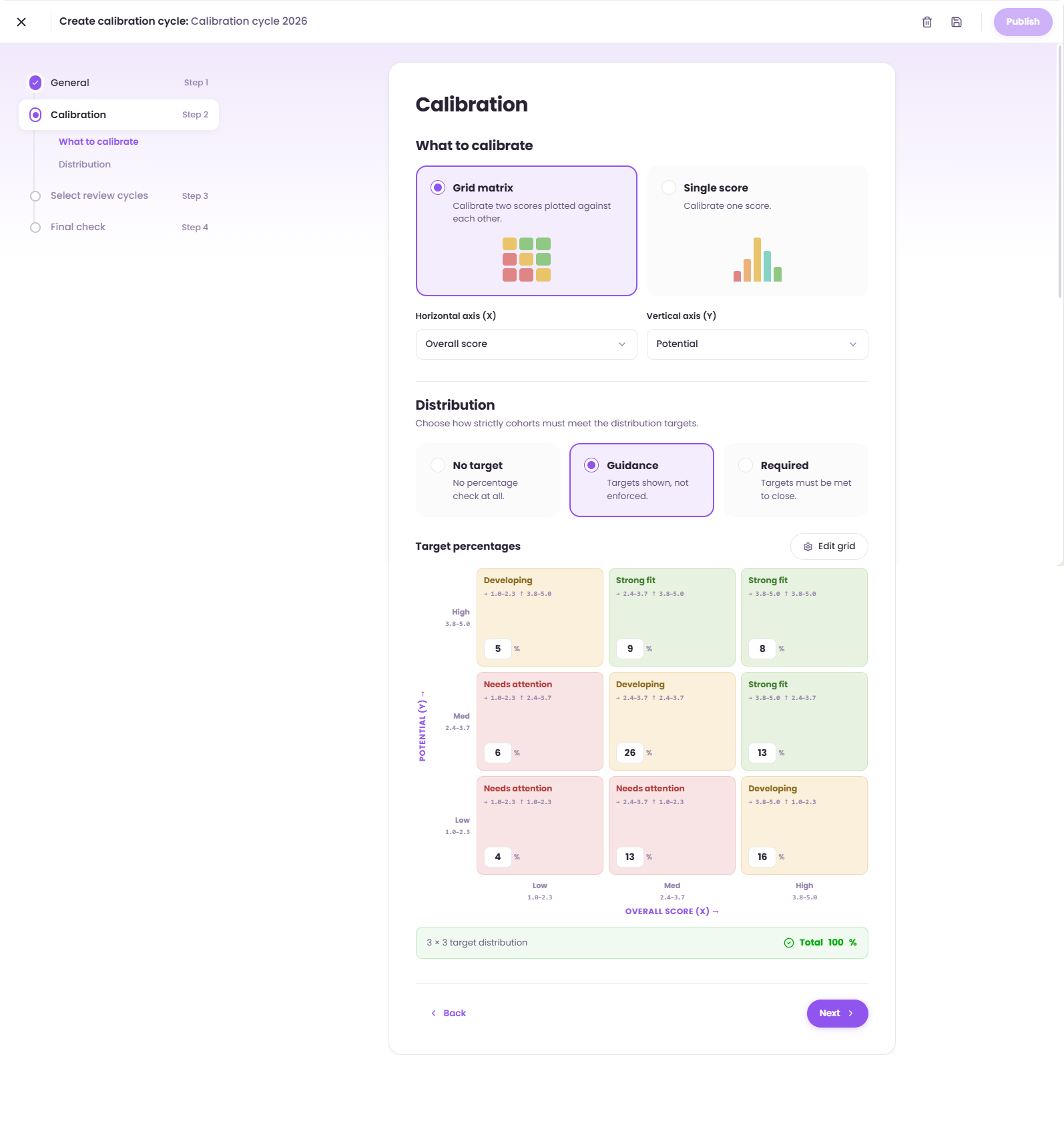
How strict is the score distribution? I proposed three levels: no target, guidance and required. → All three, as a setting.
Prep is optional. Should live-only sessions be possible too? → Yes, also as a setting.
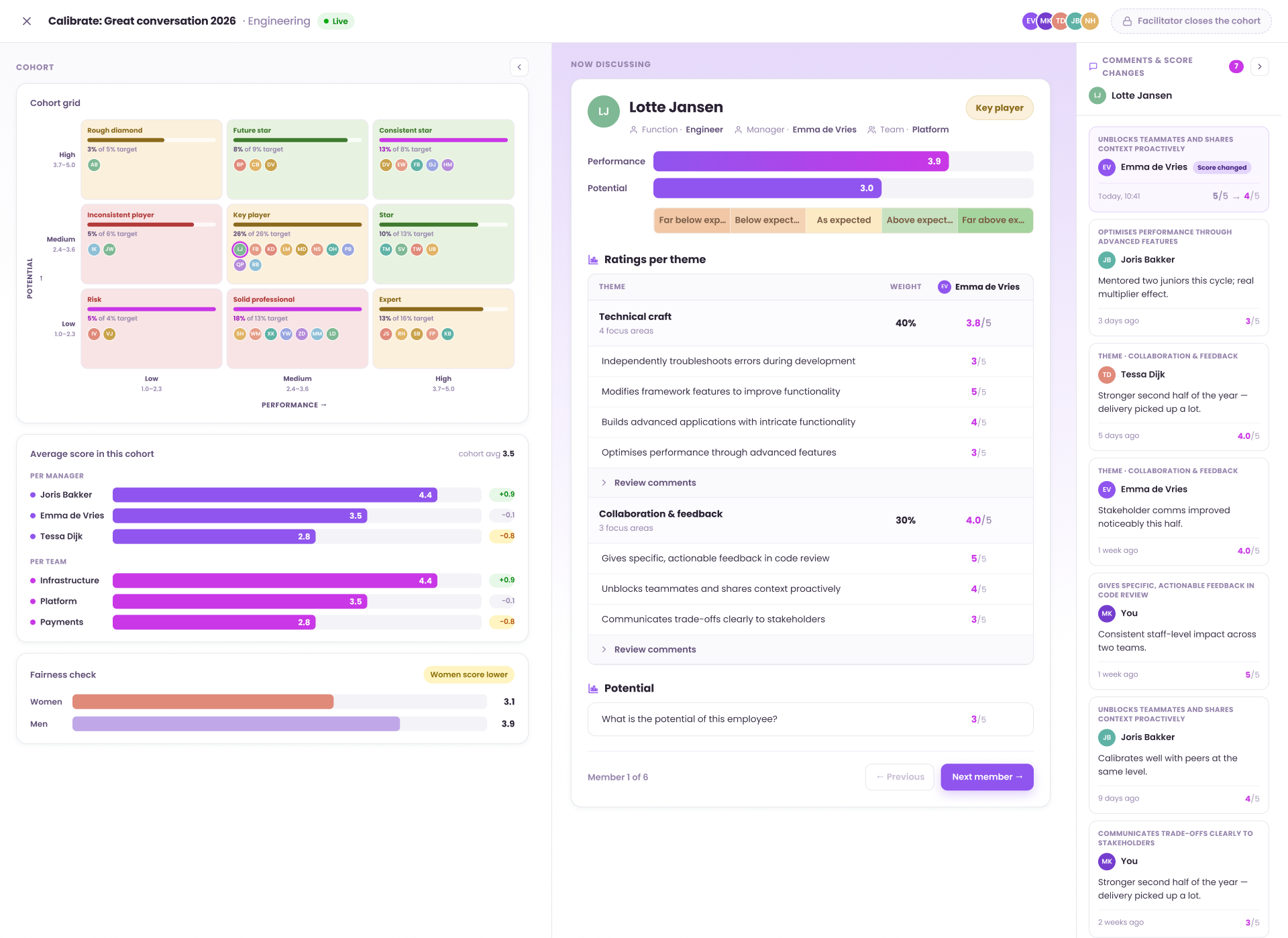
Then the Head of Product reviewed prototype v1, and that brought the first turn. Calibration shouldn't hide behind that toggle in the review cycle. It needed its own cycle, with the flexibility and room to grow. I also learned that most companies calibrate in a 9-grid of performance against potential, and that cohort statistics matter, like the average score of men versus women. All of that went into prototype v2.
3. Testing: less is more
I tested v2 in interviews with customers. The biggest finding: prep, a whole part of my concept, wasn't realistic. Managers simply don't have the time. The stakeholders agreed, so prep left the MVP; managers can still prepare from the dashboard.
Two more lessons:
The session dashboard felt overwhelming, and the employee's own answers weren't needed there.
Managers think in totals. But in Learned the overall score is an average of underlying scores, so changing those had to be easy.
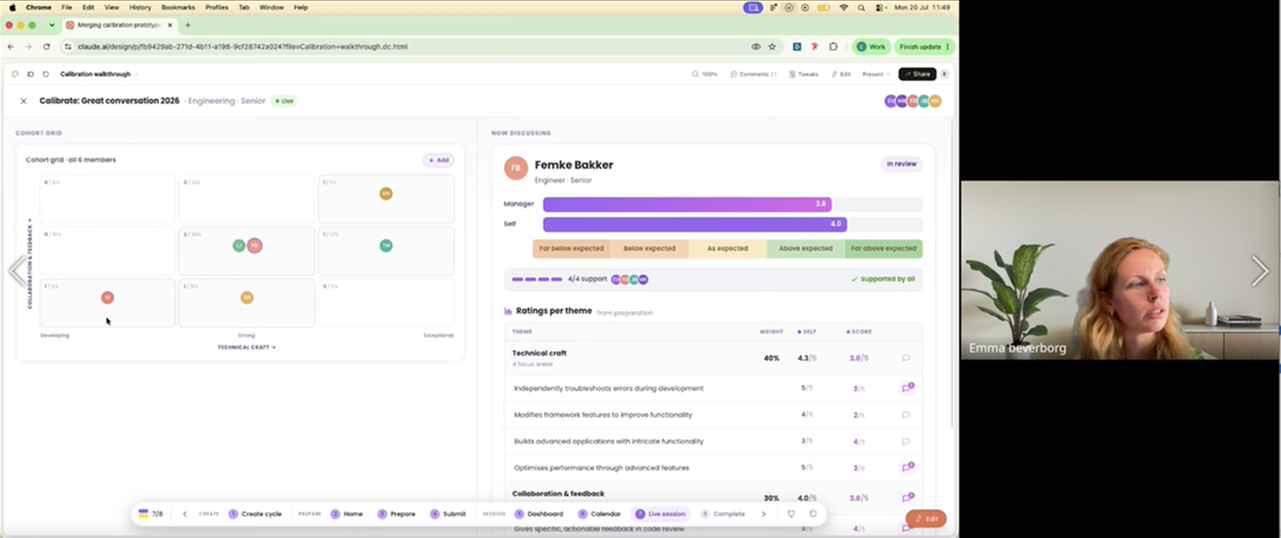
I walked Customer Success, Sales and development through the concept, and presented it at the company strategy event. Colleagues reacted positively and said they'd be glad to have it. I love how a Claude Design prototype wows non-technical colleagues, and how that opens the door to honest critique and real needs. The stakeholders sharpened the concept:
The Head of Product asked for a calmer session and a simpler create flow: all the cohort details were too much.
Sales pointed out that managers already write insights about employees: perfect proof to back up a score. So session comments can come from insights too.
Development asked whether the 9-grid could reuse the settings from Reports. Since the method often comes from a consultant and rarely changes, the 9-grid now lives in the company settings, set up once.
Testing v2 with a customer
4. The concept I delivered
The concept I handed over, now in development:
A simpler create flow: choose the themes, add the reviews, plan the session, do a final check.
A calm session page: names and average scores next to the 9-grid, with stats and comments in collapsible panels.
Traceable score changes: a change leads to the underlying scores and is always logged.
Delivered · CreateDelivered · Session
Reflections
This project taught me to build a complete concept in Claude Design, from the create flow to the live session.
It also made me think a level higher. Out of necessity, I took on a large part of the product owner role. Instead of asking “how do I best show this?”, I kept asking what the feature had to do, for whom, and why.
The hard part was keeping an overview: the prototype grew fast, and tracking versions and feedback took effort. My ongoing challenge is turning a Claude Design prototype into a finished design development can build from.
Next time I'll use a stricter screener for user tests: some participants didn't calibrate at all yet, which made their input less relevant.